
Life Is in the Blood: Nolan’s Odyssey and the Law of Strangers

The Odyssey (2026) is a web of stories, smaller stories that weave into the bigger story of ambition, betrayal, greed, oppression, hope, resilience and the triumph of the human spirit. Zeus’ Law of the ancient Greek society is mentioned many times by different characters in the movie. It is central to the message the film passes in different forms. The law, also known as Zeus Xenios, demands respect and care for strangers, as with any law, it has rewards and consequences.
The Trojan Horse and Zeus’ Law
The movie opens with the Trojan horse by the sea and a young soldier guarding it. This is a directorial pivot in Nolan’s adaptation where tension builds. An army of horse riders gallop towards him, without asking questions they shoot at the stranger mortally, just because they could. Before he dies, they extract what the metal horse was from him - a gift, a peace offering from the Greek army believed to be on a retreat. The fatal consequences for the givers and receivers of the Trojan Horse were catastrophic. Both sides breached the code of friendliness to strangers.
This activated the film’s mini and meta narratives about Zeus Xenios on both sides.
I had watched Wolfgang Petersen's 2004 film Troy, inspired by Homer's Iliad, in which Brad Pitt played Achilles with the famous line: “Is there no one else?”, reminiscent of the biblical Goliath taunting the army of Israel. So, I was curious about what directorial ingenuity Christopher Nolan’s adaptation is bringing to the epic poem.
Lessons from Monsters and Witches
Three scenes were remarkable for me, among a string of unforgettable stories within The Odyssey: the scene with Cyclops, the one-eyed giant shepherd; that of Circe, the witch who turned starving soldiers into pigs while they feasted on her meals; and the return of the warrior- king Odysseus to Ithaca on a makeshift boat. The vulnerability in these three scenes and their symbolism touched my very essence and spoke volumes to me.
The one-eyed giant was not kind to the strangers who wandered into his cave; he breached Zeus Law, by exhibiting the vulnerability of physical power without temperance. Circe breached the code by preying on the famished soldiers’ desire for food, she was unkind to the soldiers. She acted on their weakness, created by hunger and desire. The returning king and warrior was then tempered by his experiences.
Odysseus Humbled by the Sea
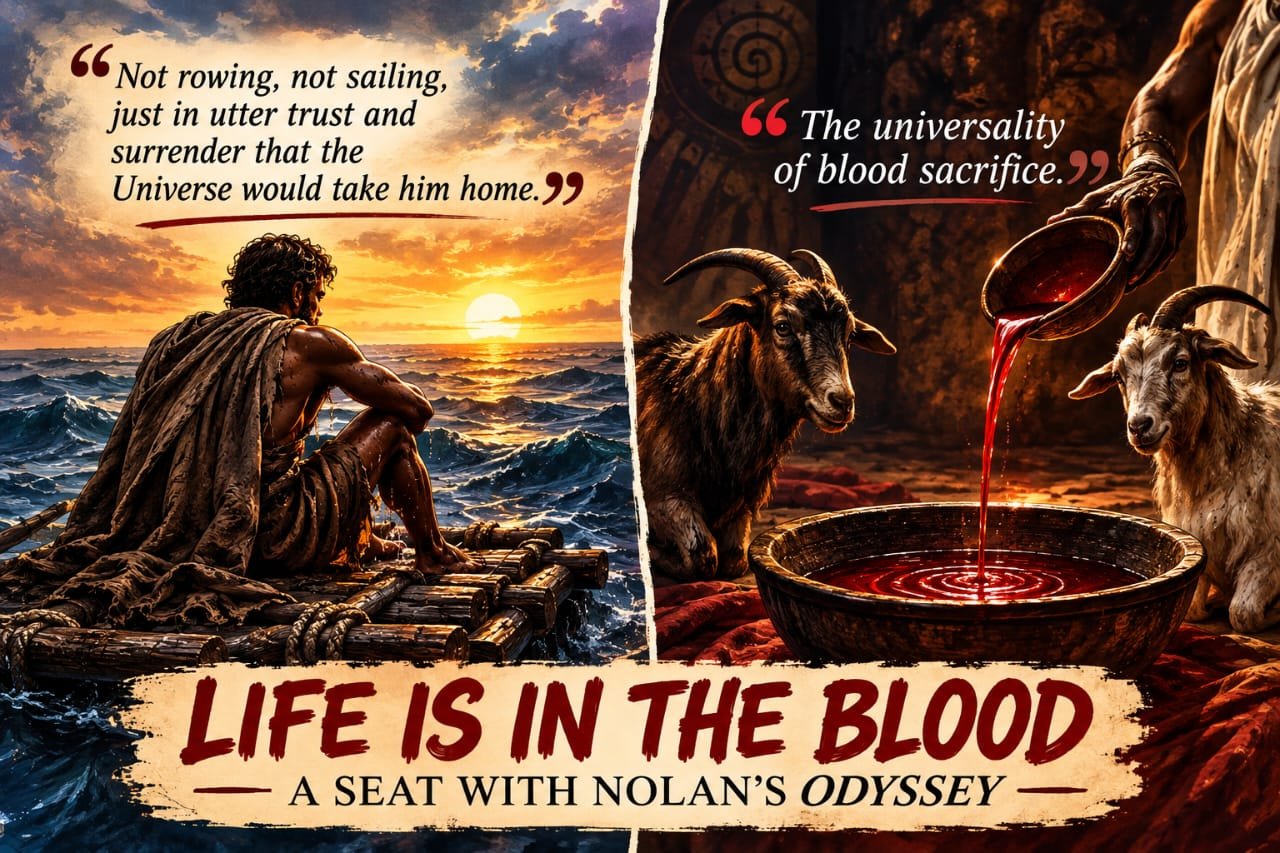
As I watched the contraption he set sail with, I marveled at how the Universe, through a succession of events, had humbled him. He typified the helplessness of a man whom life had happened to. Odysseus submitted to the waves of the sea. Not rowing, not sailing, just in utter trust and surrender that the Universe would take him home. It was moving to see this brilliant and exceptionally courageous warrior without a struggle, the vulnerability of a man stripped of status, power and agency.
I watched The Odyssey through the lenses of the Yoruba culture, Christianity and Islam, drawing parallel stories from the three.
The mini story of the soldiers with Circe was the longest, most poignant and symbolic to me. I harvested ten life lessons from the singular encounter, which I have distilled into five cross -cultural takes:
Hunger, if anything, is an intense emotion that can make you do dumb things, like being unguarded and running into danger.
Food is a trap. Never lay down your defense for a morsel. Those soldiers, like Esau in the Bible, who surrendered his birthright to his twin, surrendered their weapons. For food. To a woman. An unfamiliar woman.
Be observant. Study your environment. Things are not always what they seem. There are always red flags, tell-tale signs.
Intuition is important for a leader, for anyone. It is your personal GPS. It is seldom wrong. Leadership is not only in the glamour and power. Odysseus’ intuition took him uphill to his soldiers who were clearly in danger.
Negotiate your way into power. That’s what Odysseus did with the powerful Circe. He turned the power dynamic to his advantage.
Blood Sacrifice Across Cultures
The most striking spin-off spectacle from Circe is the blood sacrifice, the universality of blood sacrifice. I almost leapt off my seat seeing that scene play out on the screen. The fact that the blood of two goats was what Odysseus sacrificed, on the instructions of Circe, to hear the grievances of his dead soldiers and receive directions from them.
That was unforgettable for me -- it cuts through Christianity, Islam and my Yoruba culture.
The Islamic festival of Ileya (Eid al-Adha) commemorates Ibrahim’s willingness to sacrifice his son, Ishmael, in obedience to God. While Islam honors this act of supreme devotion, In Christian theology, Abraham’s willingness to offer his long-awaited child of promise, Isaac, serves as a typology forecasting the ultimate, one-time redemptive sacrifice of Jesus Christ
Isese adherents in Yoruba land, South West Nigeria are perpetually vilified by other faiths for centralising sacrifices, yet the practice cuts through cultures globally. It is the philosophical and spiritual crescendo of the movie. It’s right smack in the middle.
Life is in the blood.
I look forward to that moment all over again, when I return to the cinema to watch The Odyssey a second time.

An installation of a Greek helmet promoting The Odyssey at a Cinema in Lagos