
A Day of Birdwatching at Tarkwa Bay with Lekki Bird Club
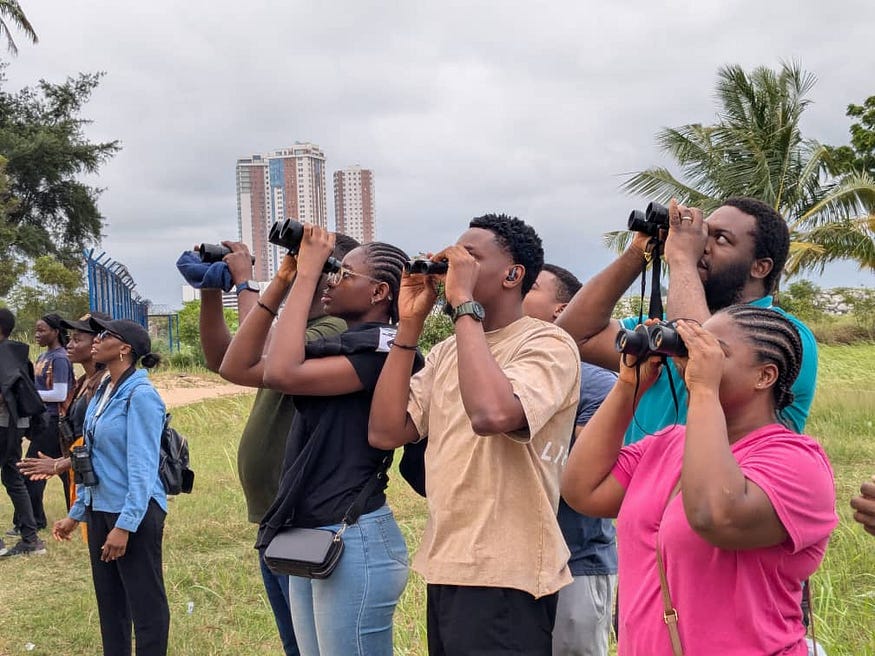
All photographs published in this piece, except otherwise stated, are courtesy of the Lekki Bird Club
Almost halfway through the walk, we hear a string of whistles to our left. A few of us stop, move closer and lean forward, hoping to catch a glimpse of the bird making the sound.
“That’s the Yellow-crowned Gonolek,” Tayo Okunaiya says with the tone of a long-term birder. “You can only hear the sound, but you won’t see it. We hear the sounds on many of our previous walks, but we hardly ever see them.”
Today is the monthly bird walk for August, hosted by the Lekki Bird Club, and it is fixed for Tarkwa Bay. Leading the admin team, Tayo coordinates the club’s monthly outings, determining the birding location each time. In the past, the group has visited the National Theatre, University of Lagos (UNILAG), Ikeja Saddle Club, Lakowe Lakes Golf Estate, LUFASI Park and the Lekki Conservation Centre.
While I have been a member of the WhatsApp community, reading a continuing stream of messages over the years on birding and environment-related subjects, today is the first time I will join the group for a walk in person.
Fifteen of us arrive on schedule (7 am) at the NAPEX Jetty (Ahmadu Bello Way), from where we climb into two boats and travel on the lagoon to the location for the day’s walk.
The boat ride lasts about 15 minutes and we arrive at Tarkwa Bay before 8 am. At that time of the day, the beachside is quiet, and only the boat operators and ticketing folks are around, screening every visitor. We’re cleared in no time and two on-site guides lead us on the walk.
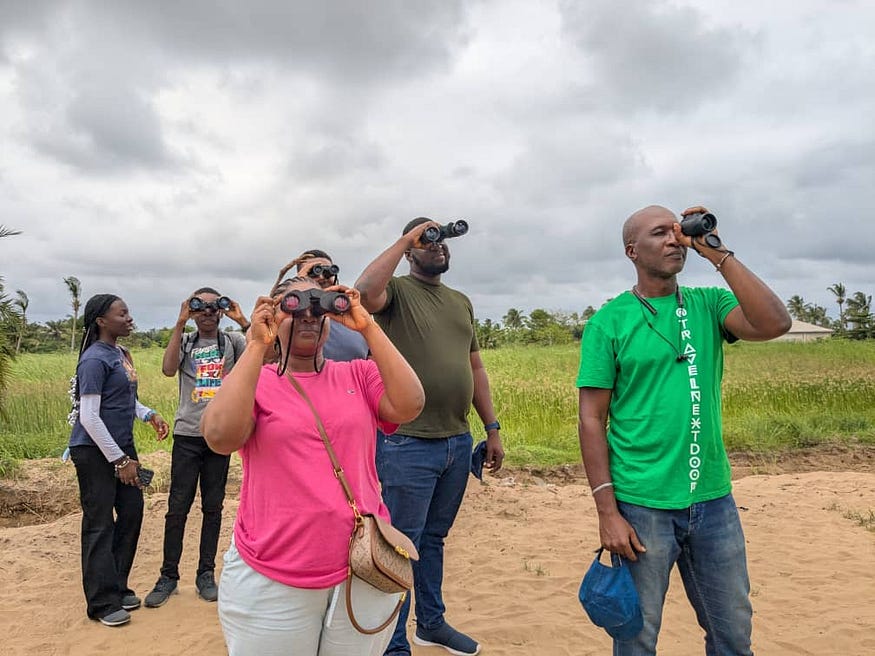
With some members of the Lekki Bird Club, looking out towards the birds in the distance.
Shrubs, bushes and trees flank our path — and, as expected, birds. On Tarkwa Bay, as I’m finding out myself this morning, birds of all shades abound.
At the start of the walk and right to the very end of it, birds sing all the way. And as we make our way past makeshift and bungalow buildings, the first birds we see are Rose-ringed parakeets, nestled high up on pine trees, followed by a pair of Speckled Pigeons; further down the path, we spotted Blue-Spotted Wood-Dove, African Palm Swift, Spur-winged Lapwing, Woodland Kingfisher and Common Sandpiper.
At each sighting, members would raise their binoculars and focus them on the birds. I don’t have one, so I would occasionally grab a monocular from the nature and adventure photographer, Dotun Ajibade (he also owns a Praktika binocular).
Ajibade is the reason I’m part of the Lekki Bird Club in the first place. Our paths first crossed in December 2018, when we travelled together as part of a four-person road trip across Nigeria’s western region. The 10-day, four-state adventure peaked with a hike up Oke Idanre, Ondo State.
Sometime in 2021, after noticing that he frequently posted about birds on his Instagram account, I commissioned him to write a mini-guide for anyone interested in birdwatching in Nigeria. Weeks later, my publishing outfit, in partnership with TRAVU and a design team, produced an e-guide to Birdwatching in Nigeria. In addition to supporting Tayo or standing in as lead when Tayo is absent, he is responsible for logging the monthly observations on ebird.org.
Some 45 minutes of bird spotting, expert insights and small talks later, we finally get to the Lagos lighthouse, where we take a 30-minute break. Built in 1890, the towering conical structure now stands as a relic of a bygone colonial and maritime era. Like many travellers, I have often fantasised about getting inside one, so I am excited that we get an opportunity to do just that — for a token.
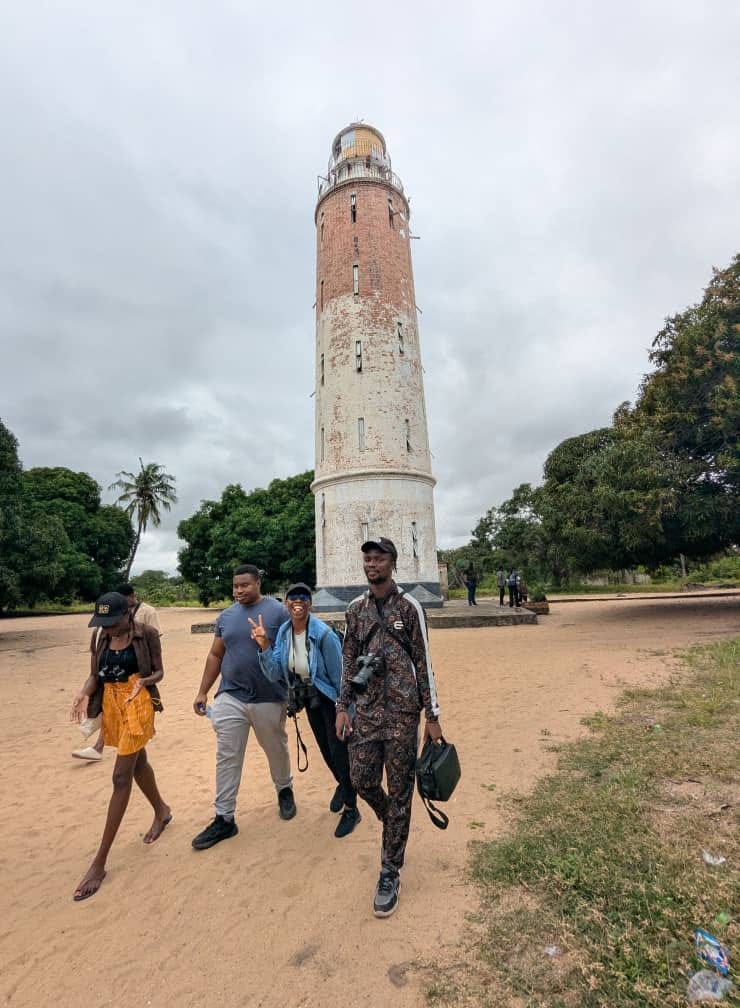
Waling and loving it — the Lagos Lighthouse in the background
Although no longer in use, the lighthouse served an essential navigational purpose for over a century; if anything, it deserves to be restored, even if only as a nostalgic landmark. What’s more, the immediate vicinity could serve as both a picnic spot and a campsite.
And so in I go, picking my steps up the spiral stairs. Instantly, I notice the decay of the steel rails, and my nostrils pick up the stench all around. Some of the wooden parts of the interior have also fallen apart, but the floorboards are nearly intact, though weakened somewhat.
From the balcony level, the most heartwarming view of the Lagos coastline I have ever seen stretches before my eyes. Beyond it, hundreds of miles away, ships of varying tonnage appear static on the Atlantic Ocean. Without a doubt, they’re heading westward to the harbour.
We climb down soon afterwards. After the break, we pose for pictures and the guides lead us on a short trek through a bush trail towards the beachside.
“Can you see all the birds there?” the older of the two says, pointing to the shore in the distance.
What birds? Where? I’m lost. I see nothing.
Oh, wait.
In seconds, my eyes adjust to the view, and like magic, the green-and-white birds come into view. They blend in with the polluted sands, which is why it’s hard to see them in the first place.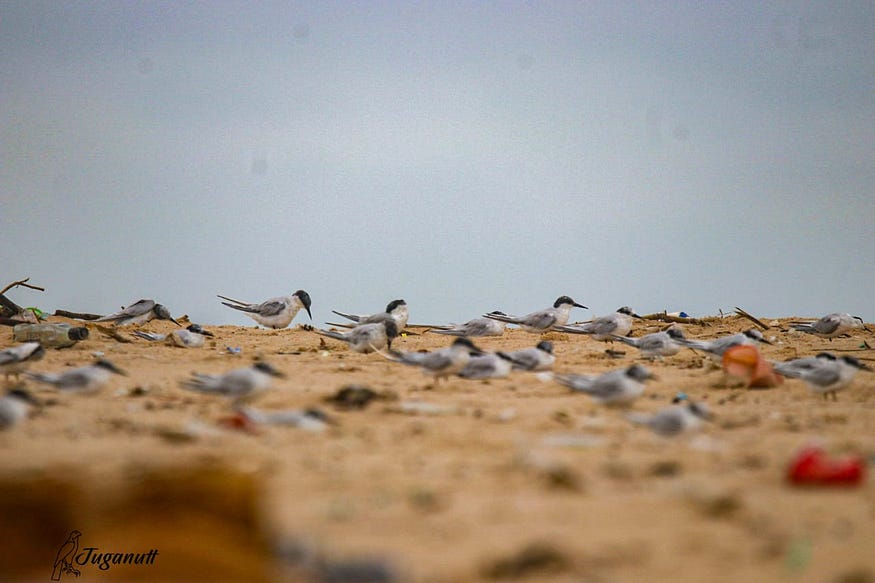
A flock of Terns at the Lighthouse Beach. Image copyright: Tayo Okunaiya
There are dozens of them, perched still and all facing eastward — like they were expecting a delegation of other birds. Besides the lighthouse, this sighting is the other highlight of the day’s walk for me.
“They are Terns,” Tayo chips in again, before moving closer and — as he has done throughout the walk — positioning himself to take the shots (with a Canon EOS 80D + Sigma 150–600mm Sports Lens). Later, long after the walk, he would confirm that they were about two flocks, totalling 50–70.
I help myself again to Dotun’s monocular, and I spend the next couple of minutes adjusting the lens to view them up close. On our way to rest at the designated private beach, we spot more birds: Black-headed Heron, Lanner Falcon, Western Cattle-Egret and Senegal Parrot.
“Why is Senegal Parrot so named?” one of us asks. “Did it migrate from Senegal?”
Not quite, Tayo says. “Probably the birder who first identified it did so in Senegal, but it’s common to the West African region.
Press enter or click to view image in full size
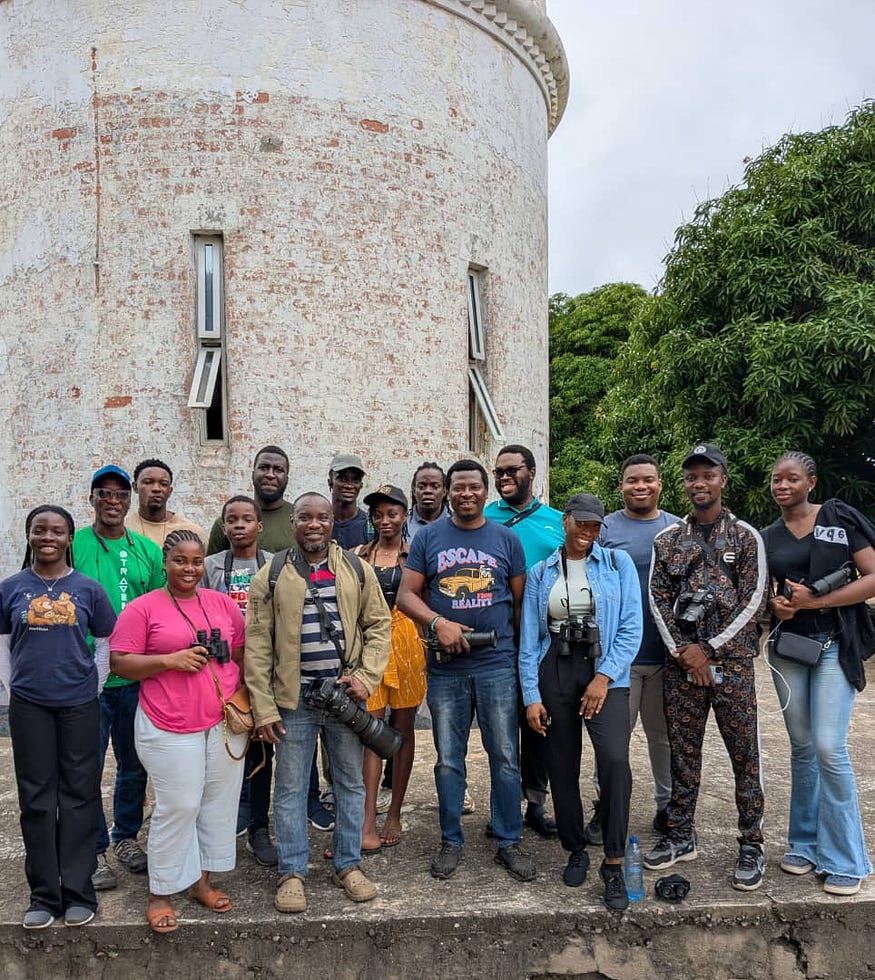
BREAK TIME AT THE LAGOS LIGHTHOUSE with Members of Lekki Bird Club on the Tarkwa bay bird walk (August 2025)