
The Road to Cotonou
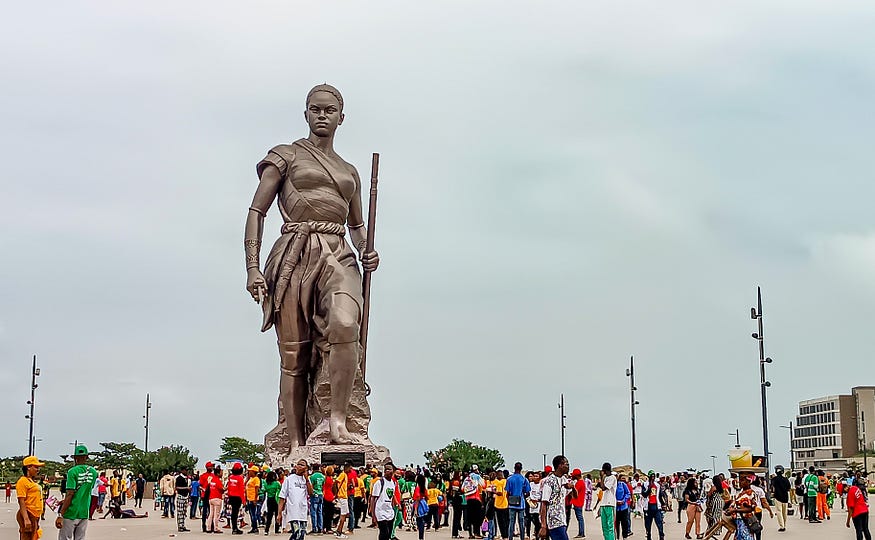
The imposing sculpture of the Agoojie of the Old Dahomey Kingdom in Cotonou pulls tourists daily. Image by Mfon Cyril Udoh
“Idiroko, Idiroko!”
The taxi driver who stood by the bonnet of his car was screaming his lungs out as he scouted for passengers in the scorching afternoon sun. Intermittently, he wiped off goblets of sweat that formed tiny rivers running down his sunburnt brown face with a time-worn handkerchief. His car, a rustic grey jalopy, already had three passengers: one in the front and two in the back seat. He was joined in the shouting match by a tout, a middle-aged man wearing a white singlet over brown khaki shorts. The latter stood by the boot of the car.
“How much?”I asked as I moved closer to the vehicle.
“Seven hundred naira,” he bellowed.
I scanned the faces of the occupants. There was an elderly northerner in the front seat. Two other men, a middle-aged man and a younger man probably in his 30s, sat at the back. Satisfied, I dropped my travelling bag in the boot and was standing by the car door when it dawned on me that four passengers were to be sandwiched like sardine in the back seat of the small car for the journey from Owode (Ogun State) to the famed Idiroko border.
We were soon joined by a woman in her 50s. Our driver sped off, stopping only when flagged down by plain-clothed Nigeria Customs officials at checkpoints. They waved us on once they looked into the car and sighted the elderly Alhaji in the front seat with the driver. I concluded that Alhaji, who looked distinguished with long, grey beard and grey hairs jutting out of his Arewa cap must be very influential and well-known along that axis to command such respect. His presence inadvertently provided us cover from searches. Although I had my valid travel documents, no soul asked me for them at the numerous check-points that dotted the stretch along the corridor to the border between Nigeria and Benin Republic. For a first timer, my safety antennae was up. I presumed that the less I made it obvious that I did not know my way, the better for me.
When we got to the bus stop before the last, Alhaji and the woman having alighted earlier, I asked the driver if that was his last bus stop.
“Do you want to cross the border?, he replied.
“Yes.”
“Don’t worry, I will take you to the right place. If you get down here,the bike riders would charge you higher to take you across the border.”
He stopped me at the petrol station at the last bus stop and pointed out a band of commercial motorcycle riders. “Ask any of them; he will take you across the border.”
I asked the first biker to take me across, and he agreed, at the cost of one thousand naira. I had presumed it would be a journey over some kilometres manned by Customs officials who would scrutinise my travel documents and ask probing questions. But no! Instead, the biker took me down a windy bush path on a slope with ‘checkpoints’ — barricades made by putting bamboo sticks over sticks dug into the ground. He tipped the men manning each of the posts between N100 and N200 each until, in less than five minutes, we reached a considerably big clearing, the motor park on Benin Republic soil.
Press enter or click to view image in full size
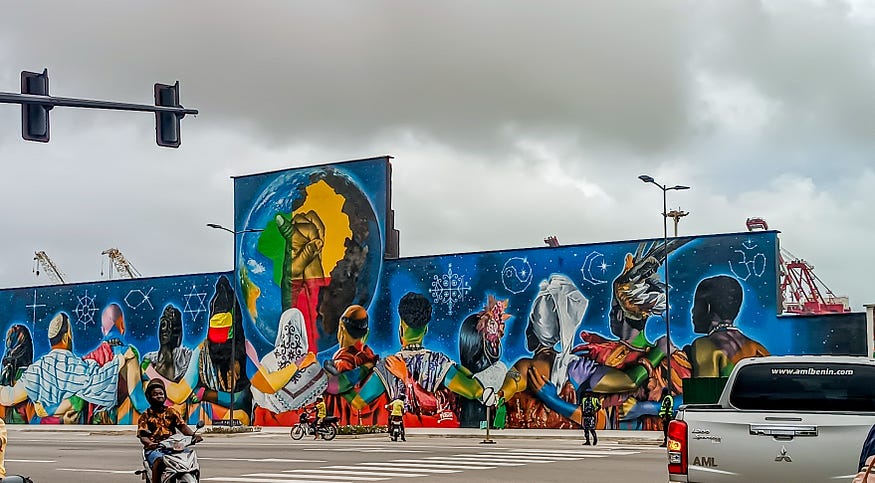
One of several murals on Cotonou’s delightful Graffiti Wall on the Esplanade des Amazons. Image by Mfon Cyril Udoh
The usual hustle and bustle at Lagos motor parks was absent. About five cars were parked. Some had boards with their destinations inscribed mounted on the car roofs. One had Port Novo, another Cotonou and yet another Togo/Ghana. Some of the drivers swooped down on me.
“Where you dey go?,” asked a man in his 60s, whose buba and sokoto made from yellow Ankara could barely hide his pot-belly. I could not respond because I did not know at that moment. All I knew was that I was heading to Benin Republic on vacation to visit some tourist sites. I had a list of places I wanted to see. Luckily, though the telephone network was not particularly great at the border, I could send WhatsApp messages, so I reached out to a friend, explaining that I was in a fix. My friend, who, in the past, travelled to Benin Republic on business trips, advised that the best place to start was Cotonou, Benin’s commercial capital. Pronto, I approached the driver of the Cotonou-bound car, a dark-skinned man in his 40 who was peering intently into his small handset.
“How much is Cotonou?”, I asked.
“Three thousand CFA,” he replied. CFA Franc? I was shocked. I was informed earlier that the journey would cost me about seven thousand Naira. My plan was to change some Naira into CFA Franc when I get into the city centre. I told the driver that I did not have CFA and he pointed out a cluster of women at the park trading in CFA and Naira.
“How much is CFA?”
“375 CFA for N1000,” a beautiful, rotund, light-complexioned woman in her 30s replied. Since the removal of fuel subsidy and the spiraling inflation that trailed it, the Naira has been rolling like a dice off the table against the Dollar and other currencies. Three weeks before the trip, I was reliably informed that N1000 could only fetch 500 CFA. I gave her N20,000 and got 7500 CFA and went back to the car. We waited for another two hours before the driver, who was, for the most part, peering into his phone, got another Cotonou-bound passenger. We set out at exactly 6.05 pm. Sitting beside the driver gave me a vantage position to take in the scenery on the road to Benin.
The moment the driver drove out of the park, he took the first turn into an untarred road and ended up at a ‘filling station’- two big transparent jars sitting on a table. At the sound of the car horn, a young man emerged from the backyard of a modest bungalow with a yellow hose and two yellow jerry cans filled with petrol. He filled the jar and handed it to another young man who carried it and a big funnel covered with an old cloth to our car and sieved the petrol into the car tank. He emptied the content of another big jar, then two small bottles. The exercise lasted for about five minutes and that was my first culture shock.
Benin Republic relies on petroleum products smuggled in from Nigeria. But for a few standing ones, Benin Republic,I was later to find out, was littered with such ‘filling stations’. However, unlike in Nigeria where commercial drivers drive into filling station at practically every trip and cannot be caught dead buying quantum of fuel into their vehicle, their Beninois counterparts put their food where their mouth is.
Our driver’s purchase made me assume that it was going to be a long journey, but just before dusk and 45 minutes of driving on a smooth, beautifully tarred road running through lush green vegetation, we burst into Port-Novo, a city of well-planned old houses, sidewalks, trees, lagoons, cars and bike riders. Surprisingly, there was no single stop by either their Immigration officials or the police!
“What about Cotonou?” I asked the driver.
“E still dey for front.”
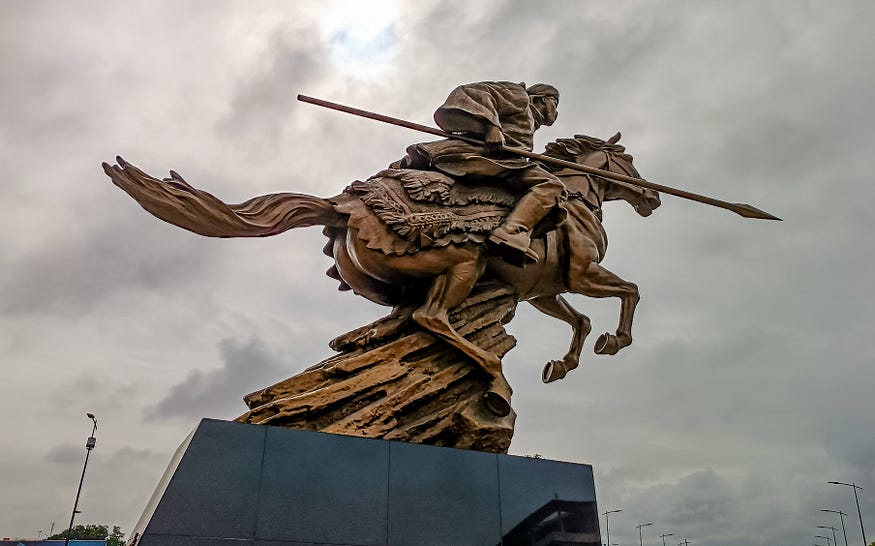
Bio Guerra, a monument metres from the Kadjehoun International Airport, welcomes travellers to Cotonou, Benin’s commercial capital. Image by Mfon Cyril Udoh
It was then that I told him that it was my first time and I needed help to find a hotel accommodation when we got there. After about 45 minutes, we ended up at the Dantokpa Market, the biggest market in the bubbly Benin economic capital. Although, it was already dark and some shops had closed, it was a beehive of activities as some traders were making last minutes sales, others packing their wares while some hawkers were still calling at prospective buyers.
After helping some of the passengers bring down their luggage, the driver drove me to a hotel close to the market. One look at the unsightly entrance of what looked like a motel, I asked him if there was another one close bythat he could take me to. He informed me that he was going back to the border that night and handed me over to a commercial bike rider whom he spoke to in Fon. The bike man who, luckily for me, understood both English and Yoruba later became my guardian angel throughout my vacation.
“Buy a sim card and call your people first, then I can take you to a hotel,” he advised me. We rode to a major street near the market, where he assisted me in purchasing a card, and in seconds, I became the owner of a Beninois phone line. He took me to a money changer where I got some CFA Franc and the search for a hotel began. Before getting to Dantokpa Market, I had seen a big Catholic Church and wanted accommodation near it but Mr O. had better ideas.
“I will take you to a hotel where you go pay 10,000 CFA per night, so that you save up money to buy food. Tomorrow, you can take a bike to the church. There is Catholic Church everywhere here.”
At the first hotel, a white, rickety two-storey building, the bike man waited outside with my bag while the hotel manager took me up the staircase to check a room on the second floor. Although the bed covers were clean, the green paint on the walls was peeling, and the tiles on the floor were brown with dirt and age. The second hotel was better but rowdy, with strange faces moving in and out — a beautiful third hotel with a cosy interior had some white men dining out in the outer court. I was shown a room with an opening under the door big enough to pass a toddler’s head. When I asked for another room, the terse reply from the manager was, “That is the only room left.”
We eventually settled for the fourth — a modest yet decent hotel at 16,500 CFA per night. Mr O. left me at about 11 p.m. with a promise to check on me the next day.
The Mass on Sunday at the Paroisse Sacre Coeur, Cotonou, officiated by a white priest, was like any other in Lagos, Nigeria. It was flavoured with Igbo, Ibibio and English hymns and choruses. After mass, I returned to Port-Novo, where a tour guide took me to the first church and the oldest Mosque. Both boasted breathtaking rustic Brazilian architecture and were built by Afro-Brazilian descendants of former slaves, according to my Port-Novo tour guide, Emmanuel. The church, I learnt, remains the spot for the gathering of Catholic faithful, locals and tourists who converge annually every first Sunday of January to celebrate the Christian festival, The Epiphany.
The oldest mosque, which took 25 years to build, was built in the Brazilian architecture of a church except for the crescent at the top. Although it is no longer in use, as a modern mosque stands beside it, it remains a rare beauty to behold. I also saw the Voduon Shrine, also known as the “Masquerade Shrine” or “Zangbeto” in local parlance. The cone-shaped hut, which depicts the shape of the masquerade, sits directly opposite a big mosque.
“Every community in Port Novo has a Zangbeto protecting it,” Emmanuel told me. We ended our rounds at a nature park by the first Parliament building. Communication was a challenge as I walked the clean streets of Port Novo and Cotonou and interacted with the Beninois. French is the official language. However, Fon and Yoruba are also major languages spoken by many. I had to find someone who understood English or Yoruba to act as an interpreter. Although very friendly and welcoming, people get frustrated when they do not understand you. The day after, I returned to Cotonou where I saw the intimidating statue of the Agoojie at the Amazon Square.
“The Amazon Agoojie fought against the Kingdoms of Oyo and Ibadan,” Amoussou, my tour guide volunteered.
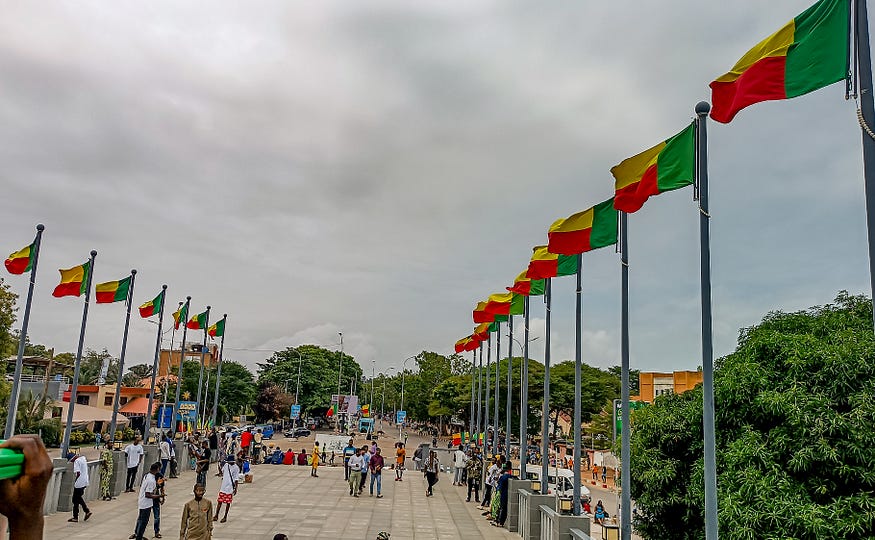
Visitors throng the Place des Martyrs in Cotonou on Benin Republic’s 64th Independence Anniversary (1 August 2024). Image by Mfon Cyril Udoh
According to him, the Agoojie was one of the ancient women warriors of Dahomey who led campaigns to stop the slave trade. History has it that King Agaja went to wars with women warriors who were revered as amazons for their prowess in the conquest of neighbouring tribes in the pre-colonial days. War captives were either sold as slaves or decapitated for ritual sacrifices to the gods.
We went to Fidjrosse Beach, an immaculate, sandy shoreline stretching kilometres from the main road. A few young men and women where either running away from the wave of water surging from the Atlantic Ocean or catching it in their hands in excitement. A young boy of about 12 was diving into the water and rolling in and out of the waves like a fish. Ammoussu told me that at weekends, the beach was busier. He wanted me to see the Snake Temple at Ouidah, but it was almost dusk.
“I will take you there at no extra cost except the 1000 CFA you will pay them,” he assured.
The next day, I was on a car ride which lasted for about an hour from Cotonou to Ouidah. Ammoussu was very enthusiastic about showing off the treasure trove and that the community is a top tourist attraction. Besides bearing the relics of the trans-Atlantic Slave Trade, Ouidah is a spiritual centre of Vodun. It is home to pythons and python worshippers and boasts of the Python Temple — a cluster of about four mud huts: one with corrugated iron roof, two with asbestos roofing and another with thatch. All were enclosed within a wall adorned with paintings of pythons and female worshippers, which also had an art store with carvings, paintings, beads and other artworks on sale.
We met Didier Aduvie, a young man of about 19, one of the descendants of the python worshippers who claimed that the Python Temple dated back to the 13th Century. Aduvie told us, with a proud smile, “We worship pythons here as gods because in the past, they protected our crops and the farms of our ancestors against rats and mice.” He went on: “People who worship pythons here are called ‘Ouidah’ and are recognised through their scars: two scars on their foreheads, two on each temple and two on each cheek. All the scars are equal to ten.”
By his tale, we gathered the scars accordingto the number of scars on a python. Aduvie announced that the royal snakes, 31 in number within the temple, are “harmless, venom-less.” He brought out one and wore it around his neck like a necklace. He offered to decorate me with it. I turned down the offer, but Ammoussu would not allow the offer slip. He took it, and his neck was laced with a medium-sized python curled around it, its small head hanging down like a pendant.
One of the intriguing things about the people of Benin is how practitioners of different religions — viz. Muslims, Christians, and Animists (Voodoo) — live side by side in harmony. A Catholic Church that overlooks the Snake Temple epitomises the high level of religious tolerance in the Benin Republic.
While returning to Nigeria, I tried a different route: the Seme Border. A car ride of about 45 minutes (700 CFA) had me at the Seme Border. Because, my travel document was not stamped at the point of entry, I was advised by some Nigerians I met at the border not to produce it or I would get into trouble.
“But no one asked me for it when I went through Idiroko Border.”
“That is not what they would listen to,” replied the young man who offered to escort me across the border. “Follow me”, he said, collecting my travelling bag and putting it in a cart, which he pushed forward. I strode after him as we strolled across the stretch, with people, including hawkers, milled back and forth unchallenged. A plain-clothed official soon accosted me, and my escort intervened, squeezing N500 into his hand. He let me walk on. We soon got to a pool of cars. He pointed out a waiting car, returned my bag and walked away.
As the metallic grey wagon driven by a stocky, light-complexioned man nosed its way towards Lagos, we rocked side to side in a non-rhythmic frenzy, no thanks to the pot-holes-riddled road, a heart-breaking departure from the smooth ride from Cotonou. We were stopped for checks at over 14 checkpoints manned by Customs officials and touts, most probably in cahoots. At some of the stops, we were waved, after some hailing by our driver who volunteered, without being asked, that he retired as a Police DSP. At some others, he squeezed N500 into the waiting hands of the Customs officials after they spotted a small bale of second-hand clothes. However, at one stop, one particularly stubborn, plain-clothed Customs official dragged down the load from our boot and threatened to go away with it until the passenger it belonged to coughed out N1000.
Soon afterwards, the driver quarrelled with the owner of the troubling load. The three thousand five hundred Naira that he agreed to pay, which at the beginning of the journey the driver had asked him to hold in his hand for the ‘sorting’ of Customs officials, had been exhausted even before we got to our destination.
“When I told you that I don’t carry Okrika, you thought I was joking?” the driver fumed.
“We are not quarrelling”, the man pleaded as we arrived at the last bus stop.
This piece has been edited by Pelu Awofeso and Stella Ire Nnodi